THEOLOGY OF THE TRADITIONAL LATIN MASS #3

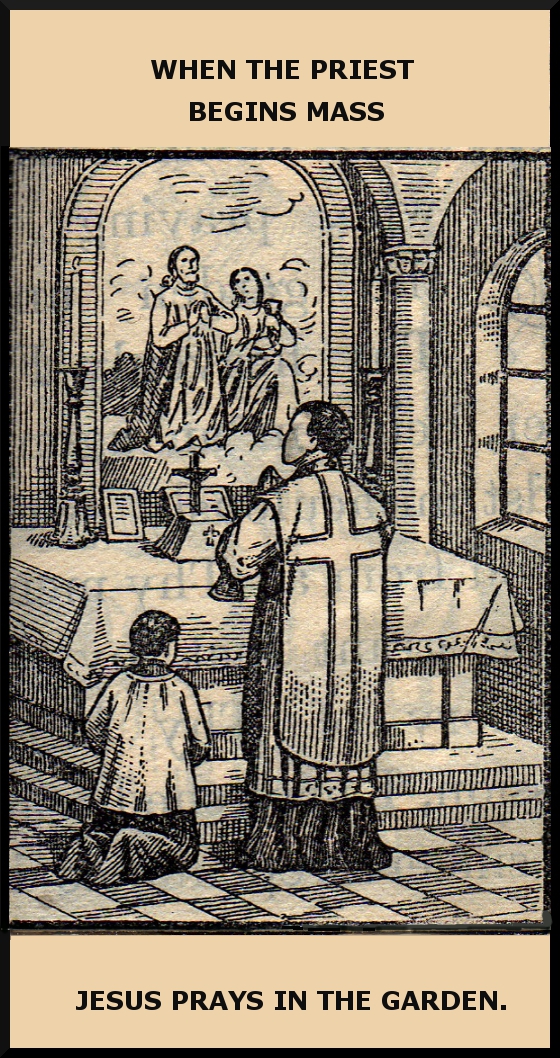
The Confiteor is prayed twice, first by the priest to confess his sinfulness, then by the server with whom we unite our hearts to confess ours.  Both assume the posture of a profound bow while asking God’s forgiveness. We recall our Lord dropping to the ground and sweating blood as He assumes the weight of our sins.

P. I confess to Almighty God, to Blessed Mary ever Virgin, to Blessed Michael the Archangel, to Blessed John the Baptist, to the Holy Apostles Peter and Paul, to all the angels and saints, and to you my brothers and sisters, that I have sinned exceedingly in thought, word, deed. (He strikes his breast three times saying) through my fault, through my fault, through my most grievous fault, and I ask Blessed Mary ever Virgin, Blessed Michael the Archangel, Blessed John the Baptist, the Holy Apostles Peter and Paul, all the Angels and Saints, and you my brothers and sisters, to pray for me to the Lord our God.

In the N.O. the priest and the congregation face each other while doing a “Penitential rite” together. A shortened Confiteor is one of the options.

Posted in The theology of the TLM in pictures | Tagged , , | 1 Comment

THEOLOGY OF THE TRADITIONAL LATIN MASS #2

P: In the name of the Father, + and of the Son, and of the Holy Ghost.   Amen.
I will go in to the altar of God.

R: To God, Who giveth joy to my youth.

Psalm 42

The priest and server say alternately:

P: Judge me, O God, and distinguish my cause from the nation that is not holy; deliver me from the unjust and deceitful man.

R: For Thou art, God, my strength; why hast Thou cast me off? and why do I go sorrowful whilst the enemy afflicteth me?

P: Send forth Thy light and Thy truth: they have conducted me and brought me unto Thy holy hill, and into Thy tabernacles.

“Lord Jesus Christ, Son of the living God, who, being in prayer, wouldst be comforted by an angel; grant me by virtue of Thy prayer, that when I pray, Thy holy angel may assist and comfort me.  Amen.”

The prayers at the foot of the altar do not exist in the N.O.

Posted in The theology of the TLM in pictures | Tagged , , | Leave a comment

Here’s a Good Question:

“Pope Benedict XVI has already made a start by showing us that Holy Communion should only be received kneeling and on the tongue. When will the Catholic world begin following Peter’s lead?”

The answer to that is when those in leadership position will have the humility and courage to admit that they are – and have been – wrong in not only tolerating, but actually practicing and promoting the abuses mentioned; that is, when bishops, priests, Religious Directors, liturgical co-ordinators, etc., start setting the good example in following the lead of the Holy Father.

I once mentioned to a parish priest the experiment done by which hosts were placed on the palm of someone wearing black gloves, and that even when carefully picked up, there remained visible particles of the host on that glove.  He didn’t even bat an eyelid.  If  the pastor does not care, why should any of the people in the pews? If the pastor does not care, those who work under him and who consider themselves of importance in the running of the parish, are given the green light to continue undermining the Faith of all those poor children in their CCD programs, just like they have been doing for the past 30 years.

Those who do care, eventually drift away to find the nearest TLM.

I’m not holding my breath. If they held in disdain Memoriale Domini; if they equally ignored Memoriale Domini,  why would they now want to follow a mere example, an example which does not suit the fancy of their humanistic and contemporary praxis of worship?

It would take a tremendous amount of courage for a pastor to address this issue from the pulpit, and to instruct the faithful to kneel and receive on the tongue.  I just don’t see that happening.

Posted in Uncategorized | Tagged , | Leave a comment

THEOLOGY OF THE TRADITIONAL LATIN MASS#1

I am going to begin a series using graphics taken from an old book, which hopefully will help people understand what the Mass is.  If one’s experience is only with the Novus Ordo, more than likely, the illustrations will make little sense.  You will not see laity traipsing all over the sanctuary, the profanation of Communion in the hand, smiley Eucharistic ‘ministers’, etc.

Keep in mind that as the church worships, so she believes, and vice-versa, and that one’s beliefs carry-over into one’s comportment and dress when worshiping God. I know that many who have made the transition over to the TLM have marveled at the differences; that it was like a sigh of relief in having left behind what in comparison was a form of worship with Protestant-like flavor, something which smacks of a Lutheran service; a place where most people dress so casually, that one would think the whole affair was nothing more than an informal social event.

Since this will be a time-consuming labor, I will probably write very little to accompany the illustration. As they say, a picture is worth a thousand words. Here is the first one:

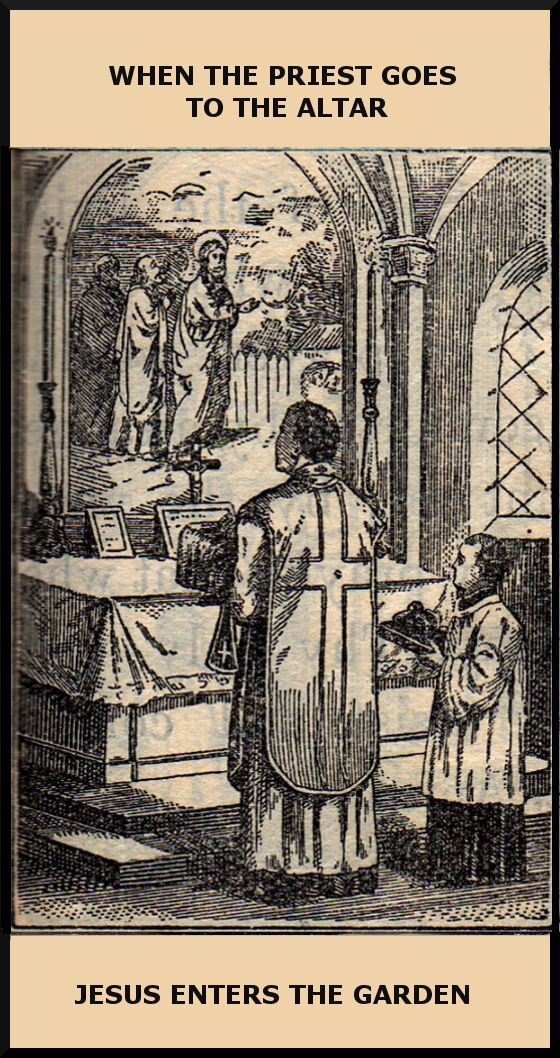
1_When the priestgoes to the altar_TLMSt. Alphonsus Liguori tells us that in order to sacrifice a victim, one must have power over its life; since God is the only one to have such power over his Divine Son who is the Victim in the unbloody Sacrifice of the Mass, it is a duly ordained priest invested with divine authority who approaches the altar of sacrifice. By praying in union with Jesus – principal priest – in the name of the Father, and of the Son, and of the Holy Ghost, he thus begins the Mass declaring that he offers the Sacrifice with the authority of the Holy Trinity.

As  the priest approaches the foot of the altar, we recall at this moment, Jesus entering the Garden of Gethsemane, where, leaving His companions at a little distance, He begins to pray.

We should unite ourselves with the priest and pray:  “Lord Jesus Christ, Son of the living God, who when Thy Passion drew near, wouldst for me wretched sinner, fear and grow sad; grant that I may ever direct all my sorrows unto Thee, the God of my heart; and Thou, O Lord, in union of Thy passion and sorrow, deign to assist me to bear them with patience, that by the merits of Thy sufferings they may be salvific to me.  Amen.”

Posted in The theology of the TLM in pictures | Tagged , , | 4 Comments

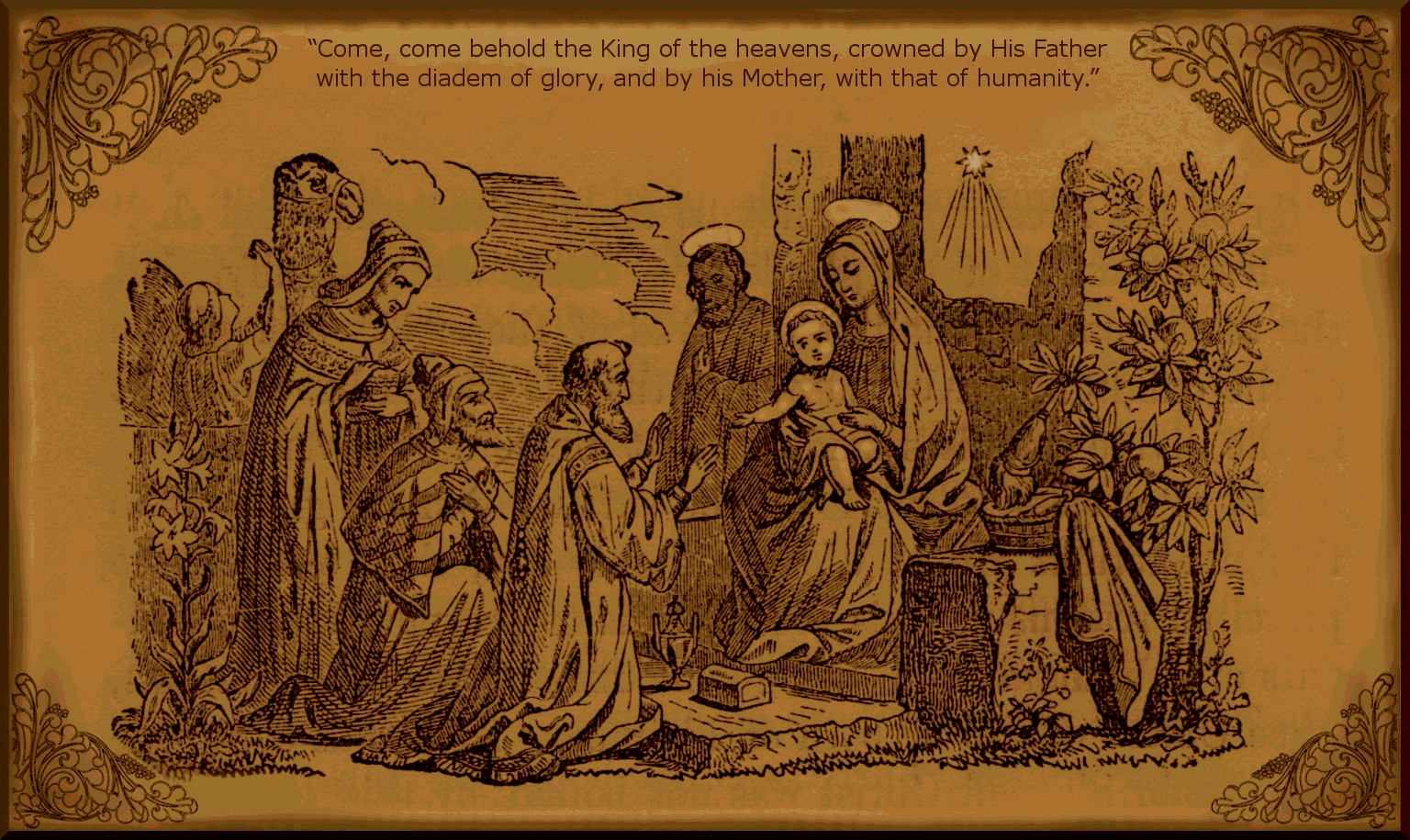
“Come, come behold the King of the heavens,…

Isaias foretold regarding Jerusalem that a “ multitude of camels shall cover thee, the dromedaries of Madian and Epha: all they from Saba shall come, bringing gold and frankincense: and shewing forth praise to the Lord.”

 This prophecy was fulfilled at the coming of the Magi to the lowly dwelling where lay the Divine Infant King born at Bethlehem.  There they adored and placed at His feet gifts of frankincense, gold, myrrh, thus solemnly acknowledging the Kingship and  Divinity of the Man of Sorrows. (As I write this, I can’t help but recall a mandatory catechetical session I once attended.  The presentation by a priest was on the Gospel Infancy narratives according to the mind of Raymond Brown.  For those of you who may not know, this quasi-heretic Brown, did not believe, among other things, in the historicity of the visit of the Wise men. Needless to say, I was fuming as I left the hall.)

But back to my subject:

Although the gospel of Matthew does not divulge much regarding these visitors, there are things that tradition does tell us: for example, their names and that they were not only Wise men, but indeed, also kings; for did not David prophesy that “all kings of the earth shall adore him”?  Can we not believe that these three were the first royalty to initiate the fulfillment of that prophecy?  The gifts they brought were costly and befitting the possessions of kings. Besides, the early Fathers such as St. John Chrysostom, and St. Gregory believed them to be kings.   It is also the common opinion and sentiment of the Fathers that their names were Melchior, Gaspar, and Balthazar.   Bede even gives us a description:  Melchior, “old and pale, with long beard and hair offered gold”; Gaspar, “young beardless, ruddy, who offered incense”; Balthazar, a Moor with a long beard” who offered myrrh.

Monseigneur Gentilucci, in a footnote to his monumental work, Life of the Blessed Virgin expresses the following note of interest:  “For us, on the faith of the most credible writers, we think that they [the three Kings] were Arabians, disciples and perhaps descendants of the prophet Balaam, who had foretold this star, long expected by them.  [That’s another thing Brown did not believe.  He said the part about the star of Bethlehem was made-up.]  In thirteen days they could reach Bethlehem, and we believe it the more readily, as the queen of Saba had already come from those parts to see Solomon.  All the  country, in further Arabia, such as the land of Madian and Epha, was called Saba (St. Jerome. De Locis heb.)and if the Wise men dwelt there, the prophecy of Isaias was fulfilled to the letter…”

Gentilucci further states that a camel can travel as far in one single day as a good horse will in three, and that scripture attests that they came in haste, led by the star.  If it were so, and they arrived in 13 days, the lodging where they found the Child and His Mother must have been the cave.  But why does Matthew say that the Wise men entered a house?  Well, the Hebrew language in which St. Matthew wrote, “calls any inhabited place a house, be it a cabin or a grotto like that of Bethlehem.”   Gentilucci writes that “St. Jerome in his letter to Euctochium…says formally, that Jesus Christ was adored by the Magi in the grotto where [H]e was born.  Baronius does not hesitate to give credit to the affirmation of the Holy Doctor, followed moreover by Saint Augustine, St. Peter Chrysologus, and many others…”

And with their gifts, they acknowledged the new-born Child as God, King, and Man. It is this manifestation to the world, this Epiphany, the day of the Three Kings which we celebrate on January 6.

Posted in Feast Days | Tagged , , , | Leave a comment

Life is Beautiful!

For a sophomore college class many years ago, I designed and painted a poster which depicted my philosophy of life.  Across the very top of the design were the words,  Life is Beautiful.

One of the anonymously written critiques I received from a classmate had nothing to do with the merits of my work.  Instead what I received was a scolding.   I was told that in view of the harsh realities of life with its bloody global conflicts, hunger, racial discrimination, rampant poverty, etc., my work a mockery to the many in pain.  I paraphrase because I do not recall her exact words, but you get the idea.

Well, I hope that none of you who see this post  will be like that pitiful creature.   If we are joyful, there is a reason, especially at this time of year.

Here’s one in your eye, Father Clyde!

Our Christmas recess continues.

Posted in Uncategorized | Tagged , | Leave a comment

But The Most Delectable of Fares is Our Divine Bread

The birth of Our Lord has long been celebrated with such joy and such drama in the Church’s history: Nativity plays, Posadas, the Three Kings, caroling, Christmas trees, Nativity scenes, Midnight Mass, and…….very special foods!

Is there a country without its delectable Christmas treats full of symbolic meaning? There is the German Lebkuchen, for example,which means “life cake”; so called because it keeps well, i.e., has a long life.  It is symbolic of the new Life we find in the manger, the Heavenly Bread, the Bread of angels come down from heaven Who promises eternal life to those who receive Him.

Another is the German Christstollen – which secularists have renamed stollen –  the shape of which is supposed to represent the Christ Child.  The French have their Brioche, the Scotch their Bannock, the Bohemians the Vanocka, the Portuguese the Bolo de Natal , the Mexicans and Spaniards the roscón de Reyes, etc.

In looking over an old, Catholic cookbook, I was fascinated by the way Catholics all over attached symbolism to many foods on the Christmas menu.  For instance, the book says that Armenians would celebrate Christmas Eve with a very simple meal of fried fish, lettuce and boiled spinach.  It is a tradition in that country that Our Lady supped on such food on the night that Our Lord was born!

At one time, throughout the Catholic world, Christmas Eve was not a day of feasting, but rather of fasting. Italians, typically, would also eat fish on Christmas Eve, as did the Polish, and the Portuguese, and the Spaniards. Hmmm…perhaps there is something to the tradition that our Lady ate fish that night.   Or maybe at one time the Catholic discipline of abstinence from meat was in force and no Catholic anywhere ate meat on Christmas Eve?  I like the idea of the Armenians wanting to be like our Lady.  When we love others, we want to do what they do.

The Polish Christmas Eve meal is known as the Wigilia.  Sometimes the leftovers of the Wigilia were dispensed to animals, and even to the farm trees, this in the hope that “all living things will prosper which have been fed thus on Our Lord’s first night on earth.”  (We had a somewhat similar ‘tradition’ in our home when the children were little.  My daughter would prepare a stocking for her cat which would include treats and a bit of catnip rolled up in a sock.  The cat, indeed, prospered!  But she hated the Christmas bow around her neck.)

In long-ago England, it was the tradition to serve a boar’s head on a platter, encircled with bay leaves and rosemary, its tusks decorated with fresh fruits. Inside the head were two stuffings – one consisting of pig’s liver, chopped apples, onion, sage and rosemary, and the other of sausage meat, ox tongue, truffles, apples mushrooms, and pistachios.   (The cookbook does not explain the symbolic meaning of all this.)   Another Christmas tradition was that of the roast peacock, although a pheasant would do in a pinch.  The point is that Christmas was an extraordinarily special day!

We do not celebrate a memory.  We celebrate an eternal reality made supernaturally present here and now, so that all of creation shares in the graces of every Christmas.  But the best gift is eternal life for those of good will who in humility will submit to the rule of the Child in the manger.

Whatever your meal – whether boar, peacock, pozole, besugo, or ham – a merry and blessed Christmas!
Posted in Feast Days | Tagged , , | Leave a comment

The Gravest Consequence of the Novus Ordo Mass

Hey, it is not I saying these things.   (I am happy to read, though, that Father Don Pietro Leone agrees with my thinking. )   🙂

The full article is posted at Rorate Caeli:

“The gravest consequence of the New Rite is, however, the dishonour of God[10]. The iconostasis of silence has been dismantled. The Lord is called forth in a vulgar tongue, in words composed by His enemies. His Presence is ignored, His Person is demeaned.

He is handled clumsily: if He falls, it does not matter. He is placed on unblessed tables, segregated from His friends. His garments have been reduced. He, The King of Kings in the state of Immolation, is placed in vulgar, primitive vessels. As the people stand or sit, and think that they are listening to a mere tale, He is crucified and dies before their eyes. He is raised above their heads: “Behold the Lamb of God!”: they stand and stare. He is delivered over to them: He, Almighty God, their Creator and their Highest Good. He is placed in their unclean hands. They receive Him into their darkened hearts, they brush Him off their hands, they trample over Him unwittingly, they take Him home. He is consigned to their caprice or their malice.”

_______________________________

Isn’t that the truth!

Here is part of a comment made about two years ago, and which I found on another   blog but which is still most relevant today.

“I was around during the liturgical upheavel of the 1970’s, I remember vividly the first NOvus Ordo Mass on Palm Sunday 1970, and the disapointment of the people, as we had been told that the adjustments to the Old Rite made in the years between 1965 and 1970 would be the final changes, that THIS was the Liturgy that the Council Fathers wanted. THen came the Novus Ordo with the outlawing of Latin, the disapperacne of Chant, the enforced break-up of choirs, vestments, statues, communion rails, altars and of whole sanctuaries. Communion by laypeople, standing, even on the hand, followed.  Professional liturgists and singers tried to force us to learn a new liturgy and new songs, but to no avail: catholics remained from then on forever silent.

Find the nearest TLM,  and there, alongside our Blessed Lady,  all the saints and the angels.  properly worship the Most Holy Trinity with all the due reverence, solemnity, and awe that we can give God.

The Traditional Latin Mass, the most beautiful thing this side of Heaven!

Posted in See, I told you so! | Tagged , , | Leave a comment

Who Understands Latin, Anyway?

Here Father James Fryar, FSSP  counters two objections most  often made against the TLM.

Do you ever wonder why the TLM is celebrated in a language most people can’t understand?  Is this what keeps you from attending one?

Father also responds to the question of why  the priest has his “back to the people”.


Posted in See, I told you so! | Tagged , , , | Leave a comment

The Blessed Roses

(Thank you,  Justin, for the lovely photograph! )

For those of you who obtained a sacramental rose, blessed by Father at the Mass for our Lady of Guadalupe, I post here a suggested prayer to recite in making use of the blessed rose to obtain bodily cures.  This is a prayer composed by St. Pius X, but with an interjection by me for the specific intention of physical healing:

Our Lady of Guadalupe, Mystical Rose, make intercession for the holy Church, protect the Sovereign Pontiff, help all those who invoke thee in their necessities, [make efficacious the blessing bestowed on this rose for restoration of good health to……]  and since thou art the ever Virgin Mary and Mother of the true God,  obtain for us from thy most holy Son the grace of keeping our faith, sweet hope in the midst of the bitterness of life, burning charity and the precious gift of final perseverance.      Amen.

Posted in Feast Days | Tagged , | Leave a comment